Vote counted!
Primordis microbiology asynchronous PvP strategy colony building no pay-to-win
Primordis is a free, browser-based asynchronous multiplayer strategy game set at microscopic scale. You do not command an empire — you command a single cell. Starting with nothing but a membrane and a nucleus, you grow organelles, breed specialised units, unlock mutations, and eventually join or found a colony competing against other players for dominance in a shared microbial ecosystem.
Play on your own schedule
Turns accumulate while you are offline and you spend them when you return. Nothing finishes at 3 AM, nothing punishes you for logging off for a week. There are no daily quests, no login streaks, and no routine tasks you are obliged to repeat to stay competitive. The game rewards thinking, not attendance.
What you manage
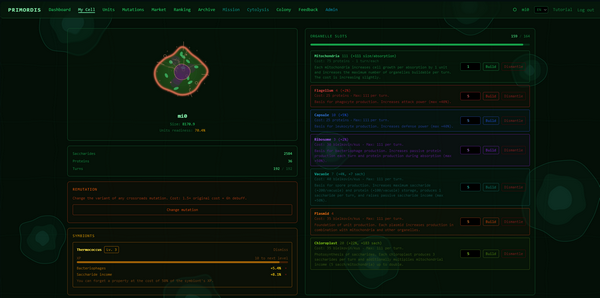
- Organelles — mitochondria, ribosomes, chloroplasts, vacuoles, flagella and capsules, each pushing your economy and defences in a different direction
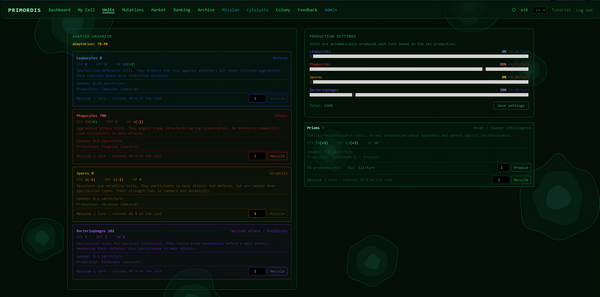
- Units — leukocytes defend, phagocytes attack, spores generalise, bacteriophages specialise in lysis, and prions run covert operations instead of open combat
- Mutation tree — fourteen positions, eight of them crossroads where every variant carries a real drawback. There is no optimal build to look up
- Symbionts — organisms with randomly generated properties that level up and permanently change how your cell performs
- Colonies — groups of up to five players sharing upgrades, negotiating pacts, and vulnerable to invasion
- Market — a player-driven exchange for trading surplus resources
Combat with actual decisions
There is no single "attack" button. You pick an operation — penetration, phagocytosis, lysis, demoralisation or colonisation — and each targets a different pillar of your opponent: their defensive layer, their stockpiles, their units, their army's cohesion, or their colony itself. Every unit type is a specialist in some operations and weak in others, so your force composition decides which attacks are worth attempting.
Outcomes are graded across seven levels rather than win/lose, and losses are proportional — tougher units absorb damage for the group, and a defeat costs you a share of your force instead of erasing it.
Systems that balance themselves
Nearly every effect is a percentage of current values rather than a flat number, so mechanics that matter on turn 10 still matter on turn 1000.
- Biofilm — a defensive layer that thickens each time you are attacked and thins slowly in peacetime, so farming a weaker player makes them progressively harder to farm
- Adaptation — army effectiveness that rises through training and real combat, but is diluted every time you add fresh, untested units
- Immune memory — your cell remembers who attacked it and how, blunting repeated identical assaults
Mini-games and PvP card battles
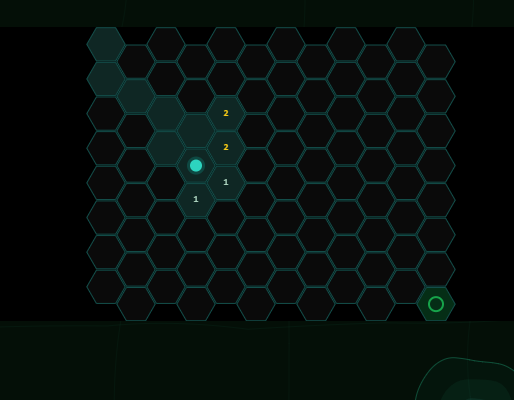
Two solo mini-games sit alongside the main strategy layer: Infiltration, a hex-grid crossing under incomplete information, and Chemotaxis, where you follow chemical gradients to collect nutrients. Beyond those, Cytolysis is a full multiplayer card duel — a 25-card deck, three resource types including ATP, separate health pools for nucleus and membrane, and three distinct win conditions. Matchmaking pairs you with another player or an AI opponent if nobody is waiting.
Practical details
- Free to play, no download, no plugins — any modern browser, desktop or mobile
- No pay-to-win, no paid shortcuts
- Currently in English, Slovak and Czech, with more languages being added
- Open beta, actively developed by a solo developer, with player feedback shaping what comes next
Primordis is for players who miss strategy games that respect their time — where a well-timed decision beats a hundred repetitive clicks.